A Change of Station: Forty Mike Mike Art is Headed to Hawaii
Every few years in the Marine Corps, life changes with a set of orders.
This summer, my family and I will be making a Permanent Change of Station (PCS) to Hawaii. While that sounds like an incredible opportunity (and it absolutely is), it also comes with the reality of packing up a home, a studio, and an entire small art business.
One of the biggest adjustments will be space. The setup I’ve built over the past few years here in North Carolina has allowed me the room to paint, produce prints, store materials, and ship orders efficiently. Moving to Hawaii will require a significant reduction in space, and at least initially I’m not certain that I’ll have the same luxury of room for creating artwork and producing prints the way I currently do.
That said, fear not.
The artist spirit doesn’t disappear just because the studio changes. Artists adapt. We improvise. We figure it out. Whether that means sketchbooks on a balcony, smaller works, or entirely new approaches, I fully expect to keep creating.
However, the move does mean I need to put some temporary boundaries on print production while we transition.
Print Orders Timeline
To make sure everything ships smoothly before the move:
May 15th will be the final day I accept new print orders.
From that point through June 1st, prints will be available while supplies last as I work through remaining inventory and prepare the studio for the move.
After that, production will pause while we relocate and get settled in Hawaii.
Looking Ahead
This move marks a new chapter both for my family and for Forty Mike Mike Art. I’m incredibly excited about the adventure ahead and curious to see how a new environment will influence my work.
Most importantly, I want to say thank you.
The support this community has shown over the past five years has been nothing short of humbling. Every print purchase, commission, message, and conversation has helped sustain this journey.
I’m grateful for every one of you.
I’ll continue sharing updates as we get closer to the move and as the next chapter of Forty Mike Mike Art takes shape in Hawaii.
Semper Fidelis,
Mike
Overcoming Creative Burnout: How to Rekindle Your Passion for Art.
As artists, we all experience moments of burnout—those times when inspiration feels like it’s run dry, when the excitement of creating seems like a distant memory, and when the pressure to produce starts to weigh heavily. It’s easy to get caught up in the cycle of pushing yourself to create, but eventually, that creative energy can run out. The good news? Creative burnout is not permanent. With the right strategies, you can reconnect with your passion, find your creative spark again, and continue making art that moves you.
1. Recognize the Signs of Burnout
Before you can fix it, you have to recognize it. Burnout doesn’t always look the same for everyone, but some common signs include:
Fatigue: You’re constantly tired, both physically and mentally, even after rest.
Frustration: The process of creating feels like a chore, and you find yourself struggling to finish even the simplest projects.
Creative Block: You can’t seem to come up with new ideas or you’re uninspired by the work you’re producing.
Perfectionism: You become overly critical of your work, often paralyzing yourself from finishing anything because it’s “not good enough.”
Disconnection: You no longer feel connected to the art you’re creating, or you’re making things just to fill space rather than because you’re passionate about them.
Identifying these symptoms early can help you take proactive steps to address burnout before it completely derails your creative journey.
2. Take a Step Back and Breathe
It sounds simple, but sometimes the best thing you can do is step away from your art for a little while. Whether it’s a day, a weekend, or a week, give yourself permission to not think about your work. It’s okay to take a break. In fact, taking time away can often reignite your passion by giving your brain the space to rest and reset.
During this time, avoid putting pressure on yourself to produce. Let your mind wander. Take in the world around you without the weight of deadlines or expectations. Sometimes, inspiration comes when you’re not forcing it.
3. Change Your Environment
A change of scenery can work wonders for your creativity. If you’re feeling stuck in a rut, try moving to a different space. Whether it’s setting up a temporary workspace outdoors, organizing your studio, or simply rearranging your desk, shifting your physical environment can help shift your mental state.
Even something as simple as taking your sketchbook or canvas outside for a walk in nature can lead to fresh ideas and renewed energy. A different perspective can give you the clarity you need to break through that block.
4. Focus on Process Over Product
When you’re feeling burned out, it’s easy to fixate on the end result—the finished piece of artwork that needs to meet expectations. Instead of focusing on the final product, try to rediscover the joy of the creative process itself.
Ditch the pressure of “perfection” and embrace experimentation. Let go of any expectations and allow yourself to play with new techniques or materials without worrying about the outcome. This can reignite your creativity by helping you rediscover the fun of creating, rather than focusing solely on the finished product.
5. Set Small, Achievable Goals
When you’re overwhelmed, the idea of creating something big can feel daunting. Break down your tasks into smaller, more manageable chunks. Instead of setting out to “finish a painting,” try focusing on smaller steps like sketching an outline, mixing a color palette, or experimenting with a new brushstroke technique.
Celebrating small wins can help you gain momentum and rebuild your confidence. Plus, these small tasks can feel less overwhelming and can help you get back into a creative rhythm without the pressure of a large project.
6. Reconnect with Your Why
Revisit the reasons you started making art in the first place. What is it about creating that excites you? What message are you trying to share with the world? Reflecting on your personal connection to art and reminding yourself why you love it can help reignite your passion and give you a sense of purpose.
If you’re feeling disconnected from your work, take some time to journal or sketch about your thoughts. Writing down your ideas, emotions, and goals can help you reconnect with your creative vision and get back to the heart of your practice.
7. Incorporate Playfulness and New Ideas
Sometimes the best way to overcome burnout is to embrace a completely different form of creativity. If you’ve been working on a specific medium or subject for a while, try something new. Experiment with a new medium, such as sculpture, photography, or digital art. Take a break from your usual subject matter and explore a new theme.
This playfulness and willingness to try new things can inject new energy into your work and challenge your creative boundaries. Even if the new projects don’t result in masterpieces, the act of creating outside of your comfort zone can help you shake off burnout and tap into fresh inspiration.
8. Don’t Compare Yourself to Others
One of the quickest ways to spiral into burnout is comparing your journey to someone else’s. Social media has made this easier than ever, with everyone’s highlight reel right at your fingertips. But it’s essential to remember that every artist has their own pace, struggles, and timeline. Your journey is unique, and it’s okay if things aren’t moving as quickly as someone else’s.
Instead of comparing yourself to others, focus on your own growth and progress. Celebrate your small victories, and don’t beat yourself up for having slower seasons. Art is a long-term pursuit, and every artist experiences periods of growth and stagnation.
In the End: Embrace the Process of Renewal
Creative burnout is a natural part of the artistic journey. Every artist experiences it, but it doesn’t have to be the end of your creative path. By recognizing the signs, taking breaks, shifting your focus, and reconnecting with your “why,” you can overcome burnout and reignite your passion for art.
Remember that art is a marathon, not a sprint. Sometimes, the greatest growth comes after taking a step back and allowing yourself the time and space to rest. So, be kind to yourself, embrace the process of renewal, and trust that the creativity you need will return—stronger and more vibrant than ever.
The key is to keep moving forward, even if it's at a slower pace. Your creativity will thank you for it.
Building a Personal Brand as an Artist: The Key to Authenticity and Success.
In the age of social media, it’s no longer enough to simply create great art. To stand out, you need to create a personal brand that resonates with your audience. A personal brand isn’t just about the work you produce (although my last blog generally suggests your art should stand alone) - it’s about how you present yourself, what you represent, and how you connect with your audience. But where do you begin, and why is branding so important for artists in today’s digital world?
1. Start With Your ‘Why’
The first step to building a personal brand is understanding the core of what drives you as an artist. What motivates you to pick up that brush or pencil? What’s the story behind your art? This is the essence of your brand. Your “why” is the foundation for everything you do. Without it, your brand risks becoming just another collection of images on a social feed.
Think about some of who you feel are the most successful artists out there -they all have a clear message or purpose that connects with people. Whether it’s telling personal stories, reflecting societal issues, or showcasing a specific technique, their message is consistent and easily identifiable. So, take a moment to reflect on why you do what you do. What’s the bigger picture behind your work?
2. Consistency Is Key
Once you’ve nailed down your “why,” consistency becomes the next crucial step. From your art style to the tone of your posts, everything you share should align with your brand. Consistency builds trust and recognition. When people see your work, they should immediately associate it with you and your unique message.
This means not only staying true to the type of art you create but also how you present it to the world. This is in no way advice to stop experimenting and developing yourself. Are you going to be professional and polished, or do you want to show your more personal side? The key is to stay authentic. Don’t try to be someone else or copy what’s trending if it doesn’t align with your true self. Authenticity is magnetic, and it will help your audience connect with you on a deeper level.
3. Engage With Your Audience
A personal brand isn’t built in isolation. You need to engage with your audience. You’ve seen it, people or organizations with a ton of potential, but they “Post and Ghost”. You should respond to comments, ask questions, and share behind-the-scenes glimpses of your creative process. Building a community around your work will help foster loyalty and increase your reach.
But don’t just focus on selling your art. Sales are a byproduct of your storytelling. Share stories, insights, and ideas that give your followers a peek into your world. People are drawn to people, not just products. Analyze your favorite brands - they dont sell products - they sell solutions. If your audience feels like they know you - beyond the artwork - they’ll become more invested in your success. And that is what makes it awesome.
4. Use Social Media Wisely
Social media is an incredibly powerful tool for artists, but it’s also easy to get overwhelmed by it all. It’s tempting to try every platform and post as much as possible, but that can dilute your message. Instead, focus on the platforms that best suit your brand. Whether it’s Instagram, YouTube, or even TikTok, find where your audience lives and show up consistently.
And when it comes to content, remember that it’s not all about selling. People want to see the real you -the struggles, the triumphs, the creative chaos that goes into each piece. When you share your authentic journey, your audience will inevidably feel more connected to you and your work.
5. Don’t Forget the Visuals
Your personal brand isn’t just about the messages you share, but also about how you visually present yourself. Every post, every story, every piece of content should be visually aligned with your brand. From the color palette you use in your artwork to the photos and videos you share online, consistency in your visuals creates a cohesive identity. (I suck at this).
Take a look at your Instagram feed. Does it tell a story when someone scrolls through it? Are your posts easy to recognize as part of your personal brand? If not, consider curating your content with intention. Choose colors, layouts, and filters that reflect your art’s aesthetic and personality.
6. Be Patient and Stay Committed
Building a personal brand takes time. It’s not something that happens overnight, and it certainly doesn’t happen without effort. But if you’re consistent, authentic, and true to your message, the payoff will come.
One of the most important things to remember as you build your personal brand is that you don’t have to rush it. It’s okay to experiment, tweak, and evolve as you go. You’re building a brand for the long haul, and patience is just as important as persistence.
In the End: Embrace Your Identity
Building a personal brand as an artist isn’t about becoming an influencer (cringe) or jumping on every tren - it’s about carving out your space in the art world, telling your story, and staying true to who you are. The art you create and the way you share it are a direct reflection of your identity. So, embrace that identity and build a brand that resonates with both you and your audience.
At the end of the day, your personal brand will set you apart. It’s the difference between being just another artist on the internet and becoming a an interaction at the PX when a guy says “Hey Sir, aren’t you that artist guy from Instagram?” (BTW - coolest feeling ever, despite my wife rolling her eyes every time it occurs!). So, get out there, share your story, and build a brand that reflects the unique artist you are.
The Efficacy of Storytelling in Art:
Beyond Technical Mastery
Scrolling through social media reveals a world saturated with art—beautifully executed pieces that showcase impressive technical skill. Some of these works stand alone, offering answers, while others do their job by leaving more questions than they provide solutions. But what I see often lacks something deeper—something essential to art that goes beyond mere technique.
When it comes to art, especially in the context of reportage and documentary styles like the Marine Corps Combat Art Program, the importance of storytelling cannot be overstated. Yes, technical execution is essential, particularly in portraits or landscapes. But in art meant to capture a moment in history, a place, or a personal experience, the power of storytelling is what makes a piece resonate beyond its surface.
Take, for example, the work of Paul Heaston, (his Instagram is well-worth the follow) a non-Marine artist whose drawings I admire greatly. His work is full of character and context, not just technical proficiency. His car-icatures (like this ‘Blue Bug’ for example) or studies of enormous Locomotives do more than simply depict an image—they tell a story. Each piece feels alive because it isn’t just about the subject. It’s about the context—the world surrounding it. Whether it's the challenge of drawing in a life drawing class when he can’t see the model or sharing a cup of coffee with his friend Clyde, Paul’s work feels like a snapshot of life, a moment that was lived, not just observed. His art doesn’t need voiceovers or captions, but these only enhance the story within.
The narrative isn’t just about what’s drawn; it’s about the emotions, the sensations, and the lived experiences that inform that drawing. Art, especially reportage art, can be much more than visual documentation—it should evoke the feeling of the moment. This is where a lot of technically impressive work falls short. There are plenty of "pictures" out there that nail perspective, shading, and form, but they lack the artist’s soul. They lack the personal injection that turns a drawing into an experience.
For instance, in Marine Corps Combat Art, there are numerous pieces that are spot-on from a technical perspective. They’re accurate depictions of military life, of combat, of training—but they don’t give us that visceral experience of the moment. What’s missing is that narrative quality, that depth of emotion that takes a viewer beyond the surface and into the heart of the scene. This is where artists like Charles Waterhouse, Mike Fay, and Victor Juhasz (and several others) excel. Their work doesn’t just show what happened; it conveys the feeling of being there.
Take Mike Fay’s paintings, for example. His work is always technically proficient and his field sketches are truly unmatched, but it’s the stories embedded in those pieces that make them so powerful. You can almost feel the tension in the air, the exhaustion in the Marines' faces, or the urgency of the moment. In these pieces, the artist’s voice—his experience, his perspective—shines through, elevating the work from a mere depiction to something far more profound.
I can say with certainty that this layer of narrative is what separates a good piece of art from a great one. The strongest works—the ones that linger in your mind long after you’ve seen them—are those that have a story to tell. Not just the story of what is visually present, but the story of what was experienced, what was felt, and what was witnessed. These elements of storytelling don’t require words—they live within the strokes of the brush, the lines of the pencil, the composition of the piece.
In the context of Marine Corps Combat Art, we need to ask ourselves: How did the artist (or perhaps more importantly, the subject(s)) feel in that moment? How did the Marines experience the moment, not just in terms of what they saw, but what they felt—physically, emotionally, and psychologically? These are the questions that elevate the work from a mere depiction to an experience that allows viewers to connect, to feel, and to understand.
So next time you look at a piece of art—be it a military scene, a portrait, or a still life—don’t just appreciate it for its technical skill. Ask yourself what story it’s telling. What emotion is it evoking? And more importantly, does it make you feel like you’re part of the story, even for just a moment?
Presence Over Permission:
The Enduring Value of Combat Art.
I’m honored to share that my latest article on Combat Art has been published in Lethal Minds Journal. This piece dives deep into the raw, unfiltered truth behind war art and why it matters, not just as a historical record but as a way to preserve the stories of those who lived through it.
In the article, I discuss how combat art differs from romanticized depictions often seen in mainstream media. It’s about capturing the real moments — the grit, the chaos, and the quiet resilience that defines those who serve in combat.
If you’re interested in understanding why combat art goes beyond aesthetics and serves as a powerful tool for storytelling, check out the full article here.
Give it a read and let me know what you think. This conversation is important, and I’m excited to continue exploring it with you all.
Social Media Mirage: Why Follower Count and Yoga Pants Won’t Make You a ‘Legitimate” Artist.
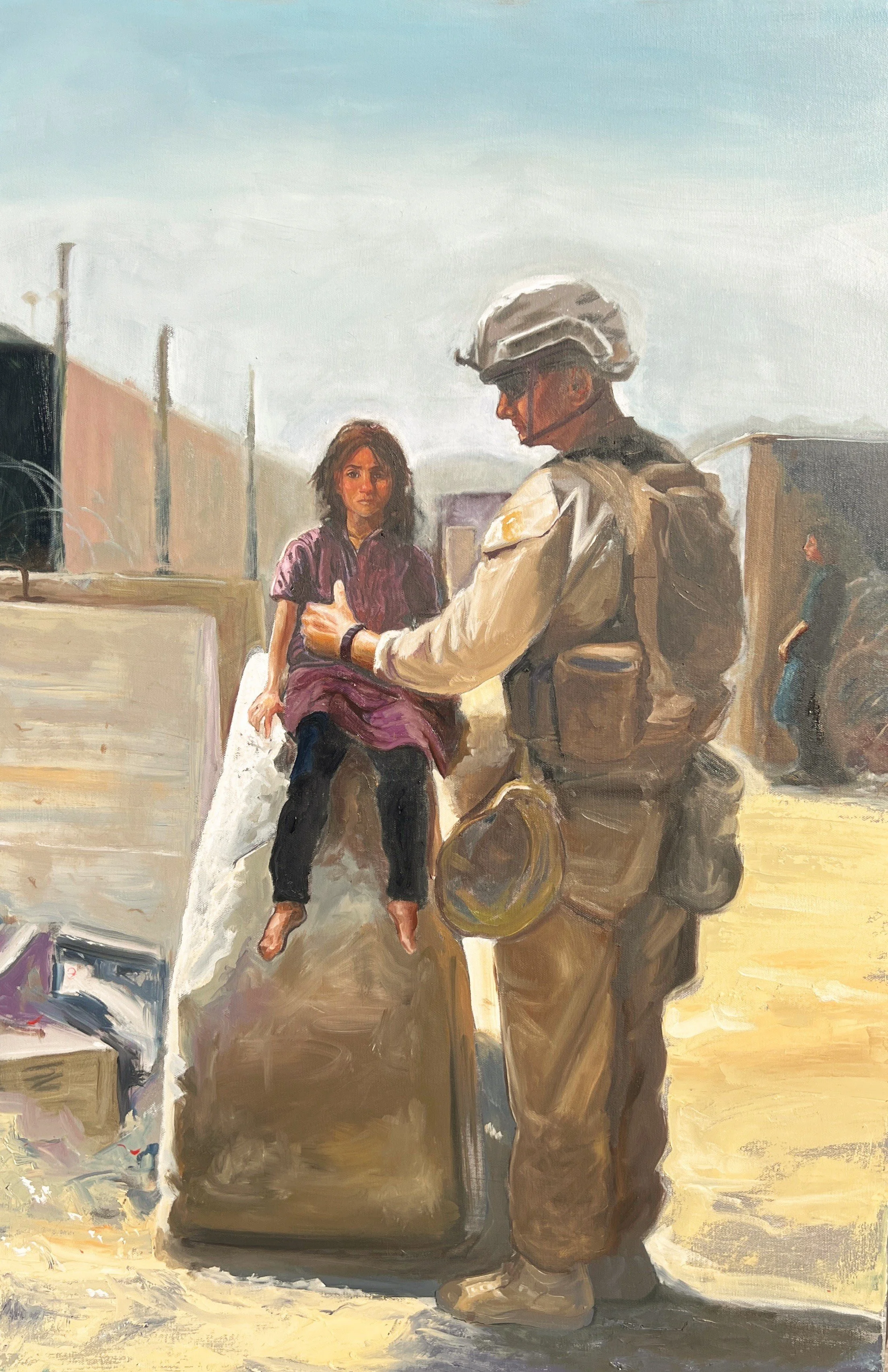
‘Misplaced’ Oil on Canvas M. L. Reynolds (2025). A US Marne assigned to 1st Battalion 8th Marines tends to an Afghan girl at he Abbey Gate during the US withdrawl from Afghanistan at HKIA.
Oof…that title makes me sound either pretentioius or jelous, but I assure you I am neither.
In a world where social media reigns supreme, the line between ‘real’ artistry and online performance has become increasingly blurred. As artists, we’ve all seen the trend - the carfully staged photos of painters holding brushes with one hand and posing provockatively in yoga pants with the other, a smile that says, “I swear I’m a real artist, just look at my followers!” The unfortunate truth is that Instagram and other platforms have created a bizzare space where engagement and follower counts have replaced actual skill and dedication. But here’s the kicker: that follower count doesn’t mean a think if the work doesn’t have substance.
It’s tempting to think that a viral post is a golden ticket to artistic legitimacy. But let’s be real - a thousand likes doesn’t make you a genius any more than a shiny car makes you a responsible driver. The cult of "likes" and "followers" has conditioned us to believe that popularity equals authenticity, but that couldn’t be farther from the truth. When an artist’s value is determined by how many eyes they can grab, it’s easy to forget about the power of actual art and the stories behind it. We’re talking about the impact, the heart, the experiences that shape each piece.
You’ve seen it. The “art” that’s been shown off with one too many skin shots, the viral post that gets a million views, but where’s the substance? If the only thing showing off is a well-placed brushstroke next to a strategically positioned backside, then we might want to rethink the narrative. As soon as the work becomes secondary to the body, it’s a sad commentary on the state of modern art’s ‘popularity contest’. Here’s a fact - when the artwork takes a backseat to the ass, the views will drop off. So, if you think your followers equate to expertise, you might want to rethink your strategy.
The silver lining? social media has obliterated the necessity of galleries as gatekeepers of art. You no longer need to be selected, scrutinized, and confined to the walls of a gallery to get your work seen. With platforms like Instagram, TikTok, and even Facebook, artists have unprecedented access to global audiences. A single post can reach thousands, if not millions, without ever setting foot in a gallery. The power is now in your hands, and that is something that should be celebrated. None of that holds a candle to the prestege associated with gallery exhibition - but its the point being seen isn’t as exclusive as some may believe.
Now, let’s be honest. If your work isn't getting the views you hoped for, maybe it’s because you’re showcasing macaroni necklaces and calling it “art” - because it isn’t. The world is more than ready for creative brilliance, but it requires more than just a good angle and hashtags. It requires storytelling. Why did you create that piece? What message are you trying to convey? What's the deeper significance? Art without a narrative is like a meal without seasoning - it may fill a space, but it doesn’t leave a mark. If that’s your niche, I’m not faulting you - we’re just from different perspectives.
Here’s my advice: stop chasing the likes. Instead, chase the meaning behind your work. Get comfortable telling the story that comes with each brushstroke, each sketch, each piece of work you create. Let your followers see the why behind your art, not just the what. Don’t fall for the illusion that numbers define your success. If the art is solid, the audience will come - for the right reasons. Stay true to your craft, and remember that real artistry isn’t built on followers, but on passion and purpose. Unfortunately, the almighty algorithm pushes your ‘content’ to audiences who might like it, learn from it, or be entertained by it. This has driven many artists to create reels - process videos, the dreaded slow reveal, and the half wit, mediocre pretty girl in yoga pants convinced that everyone is really there to love her art.
So, as we dive further into the age of social media fame, let’s keep this in mind: art’s true value lies in its authenticity, not in the viral moments or the number of likes you rack up. It’s time we start showcasing what truly matters: the art itself.
Why I Keep Making Art
There’s a question I get asked a lot - sometimes directly, sometimes in the spaces between comments on my work: Why do you keep doing this?
The honest answer: because I have to.
Sure, I get to make art as part of my profession - it’s an unbelievably important element for me, but when I say ‘I have to make art’, it’s not in the sense that it’s a chore - more in the sense that I have to breathe. Art for me isnt about chasing anything tangible. It’s not about follower counts or engagement rates. It’s not about making commissions or selling prints (though it does help keep the proverbial lights on). It’s about honoring. It’s about putting on paper what words sometimes can’t carry.
As a Marine, I’ve seen things most people haven’t (that’s not to boast or say that I’ve seen things most Marines haven’t, but less than 1% of the population has served in the military, so statistically speaking, I think it’s fair to say). I’ve stood in moments that have demanded silence, strength, and sometimes surrender to the weight of what we’ve witnessed. As an artist, I’ve tried to give those moments form, so that they dont vanish. In hopes that someone else might see and perhaps even understand. That’s what combat art is to me: storytelling through observation, shaped by discipline, and forged in respect.
Wheter I’m sketching a marine training in the cold of Norway, capturing a split-second moment of leadership, or simply trying to interpret the way light hits a rifle on a range, I’m trying to preserve something real. Something lived.
Unless it’s a field sketch, most of my artwork is made in a spare bedroom, usually with charcoal-stained fiingers and a head full of images I’m still trying to understand. Some pieces go to galleries or magazines. Some stay right here with me. All of them are part of the same mission: to document, to remember, and to share.
So if you’re here - -reading this, looking at the work, considering a print - I want to thank you. You’re a part of this story, too. And if you are an artist, or just someone trying to keep a creative flame alive while serving a greater purpose - I see you. Keep going!
Semper Fidelis,
Mike
Beyond the Medium - By Mike Reynolds
Earlier this year I set out on a journey to interview creative minds from all different creative disciplines and get after some of the burning questions I had for them, the lessons they’ve learned, and the stories behind their work. My goal was to interview 20 creatives and publish one episode per week. Though I fell a bit short, I still believe that the project was a huge success. I’d like to offer a sincere ‘thank you’ to all of the creatives that participated in the interviews including:
Episode 01: CJ Baumann Active Duty Marine Corps Combat Artist Officer
Episode 02: Aaron Courts Marine Corps Veteran turned Creative Writer
Episode 03: Nick Romer Active Duty Marine and Shodow Box Builder
Episode 04: Mike Fay Marine Corps Veteran and Marine Corps Combat Artist Officer
Episode 05: Justin Eggan Marine Corps Veteran, Writer and Poet
Episode 06: Cliint Runyon Marine Corps Veteran turned Surfboard Builder
Episode 07: Victor Juhasz Marine Corps Combat Artist and Award winning visual artist
Episode 08: Mason Rodriguez Marine Corps Veteran and Poet
Episode 09: Pat Tozzi US Navy Seal Veteran and Motorcycle Builder/Sculptor
Episode 10: Paul Heaston Art Educator, Urban Sketcher, and Visual Artist
Episode 11: Adam Walker Marine Corps Veteran and Creative Writer
Episode 12: Marc Poole Marine Corps Combat Artist and Art Educator
Episode 13: Elize McKelvey Marine Corps Veteran and Marine Corps Combat Artist
In addition, I’ve recorded but still need to edit and publish the following episodes with
Ben Cantwell Marine Corps Veteran and Artist
Kris Battles Marine Corps Veteran, Marine Corps Artist in Residence
A very special thanks to anyone who may have tuned in to listen to or watch the interviews - this project was made specifically with you in mind - and i sincerly hope that you were able to take something of value away from our discussions.
Stay tuned for future episodes! In the meantime, you can find Beyond the Medium on Spotify (search “Beyond the Medium Mike Reynolds”) or use the link here:
https://open.spotify.com/show/6pEELFCOeg7jMNdYfYIwxP?si=ugqdiGvsSYiZO3OeeoyNjQ
Until next time, keep creating, keep exploring, and we’ll see you Beyond the Medium!
Guide to Making Art Prints
Lessons Learned from My Own Experience
If you’re an artist considering selling prints of your work – congratulations! That’s an exciting step toward making your art more accessible. I only started selling prints when friends reached out and asked if they could purchase my work - I dont ever want to seem like i’m pushing sales on anyone, but if someone is interested in purchasing my [avaialbe] art, they can do so through my website. This guide is based on my personal experiences and is intended to offer some helpful tips as you navigate the process. Every artist’s business is different, and your decisions should reflect your goals and comfort level. I don’t sell prints at markets or in a physical storefront; my model is based entirely on online, print-to-order fulfillment.
Why Sell Prints?
Prints are a fantastic way to offer more accessible options for clients who may not be ready to invest in original work or who missed out on a sold piece. While a print is not the same as an original, it should aim to faithfully represent the original work. High-quality reproductions can provide meaningful value for collectors, especially when thoughtfully produced.
Print-to-Order vs. Bulk Inventory
One of the biggest mistakes I made early on was trying to predict demand and ordering prints in bulk. It left me with unsold inventory - some of which I couldn't give away. Now, I only create prints after they’ve been ordered. This print-to-order model eliminates waste and upfront costs, though it does introduce a delay between purchase and delivery. Most customers shopping online are accustomed to this, and I’ve found it to be the best balance between quality control and cost efficiency.
Creating the Image
Start with original artwork - digital or traditional. You’ll need a high-resolution image to produce your prints. I’ve found that when I use my phone’s RAW photo mode in natural lighting it works well, but for studio work or larger pieces, I use a DSLR with a polarizing filter and lights. Professional scanning services are also an option. Once you’ve got the image, edit and crop carefully. The goal is fidelity, not enhancement.
Printing: In-House vs. Outsourcing
When I began, I tried several third-party printers (Vistaprint, Printify, etc.) before landing on The Stackhouse Printery (This post isn’t sponsored, but it is an honest review). Their quality and turnaround were excellent, but expensive. Eventually, I brought the entire process in-house using an Epson SureColor P900 and Epson Hot Press Bright papers. This move allowed me to control quality and reduce costs, which helped me keep pricing accessible to my audience. No matter what route you decide, I cannot emphasize enough that quality in terms of product and process are absolutely necessary. A archival-grade Giclee print should last at least 100 years.
Packing & Shipping
Packing is a hidden cost and art form of its own. I started with rigid flat mailers, but they weren't durable - carriers bent them to fit mailboxes. I now use poly sleeves and ship prints rolled in 2" or 3” mailing tubes. The prints flatten perfectly when framed, and this method has proven the most reliable and professional-looking. I polled a select group of my collectors, and for the most part, they weren’t interested in additional costs associated with fancy or custom packaging, stickers, containers – the art was the experience they were seeking. I’ve also experimented with shipping framed prints, and found the cost was too high. Instead, I provide collectors with more economical solutions for a half-DIY/half-professional way to get their art framed and matted locally - which saves them a ton of money in the long run.
Drop Shipping?
If you use a third-party printer, you may have the option to drop ship directly to clients. That’s convenient - but I personally prefer to inspect and hand-sign each print before it leaves my studio. This is a non-negotiable element for me. If you aren’t concerned with hand-signing or limited editions, drop shipping can be a time-saving option.
Limited Editions
Offering limited edition prints can add perceived value - but it also requires discipline and organization. If you promise 10 prints in an edition: sell only 10 [Sans Artists’ Proofs, but thats another topic]. Track serial numbers carefully to avoid duplication. I use a Google Sheet to maintain a registry of every print sold, including client details and edition numbers. As a general note and my personal opinion, an edition that exceeds 250 isn’t really limited. I always chuckle when I see the work of Thomas Kinkaid in a “limited edition” of 25,000 prints. If you think you’ll sell more than 250 prints, consider an Open Edition of unlimited prints, which may significantly devalue the individual prints, but allow you to sell more in terms of quantity.
Pricing Strategy
Print pricing is a complex and often sensitive topic. A general rule of thumb is 10–40% of the original’s value, depending on availability. A $100 original might justify a $10–40 print, but don’t forget your Costs of Goods Sold (COGS). Ink, paper, sleeves, shipping, transaction fees—all of it adds up. Price too low, and it costs you to sell a print. Price too high, and you may deter collectors. Your time has value—respect it. It’s worthwhile to do market research to see what similar artists (in terms of notoriety, skill, and subjects) are selling prints for - or if they are even selling prints at all. As your skills increase, don’t feel guilty about your prices increasing too.
Is Selling Prints Right for You?
Only you can decide that. Producing and selling prints is doable—but it requires time, attention, and patience. Every hour spent printing, packing, and tracking is an hour not spent making art. But if you’re ready to take that step, I can confidently say it’s possible to do it well.
I hope this helps, and feel free to reach out if you have questions—I’m always happy to help fellow artists or answer questions from potential clients.
shoot me a DM on IG @Forty_mike_mike_art or send an email to 40mmArt@gmail.com
Nordic Response 2024
In early 2024, NATO’s largest military exercise, Nordic Response, unfolded north of the Arctic Circle, bringing together 20,000 troops from 13 countries. Among them was the II Marine Expeditionary Force, entrusted with the role of exercise Land Component Command. As an Ammunition Officer within this unit, I eagerly anticipated the opportunity to participate in this challenging environment.
Balancing my responsibilities as an ammunition officer with my passion as a combat artist presented unique challenges. While my primary duty always took precedence, I seized every opportunity to refine my artistic skills and capture the stories unfolding around me.
To fully immerse myself in the exercise, I requested to deploy early and embed with the 1st Battalion, 2d Marine Regiment during their preparatory Cold Weather Training. Supported wholeheartedly by my command, I embarked on this journey alongside Richard Johnson, a fellow Combat Artist whose talent I deeply admire.
From the moment Richard arrived at the airport, we wasted no time. Sketching the Norwegian gate guards outside our camp, we found inspiration in each other’s company and shared passion for our craft.
Over the next 10 days, we braved temperatures plunging to -11°F, witnessing the Marines of 1/2 navigate the unforgiving Arctic terrain. Despite the physical challenges, their spirits remained high, fostering a sense of camaraderie forged in adversity.
As I attempted to capture the essence of their training through sketches, I encountered obstacles, from freezing pens to numbed fingers. Yet, amidst these struggles, I witnessed the unwavering dedication of the Marines to their mission and to each other.
During a reconnaissance patrol, I had the privilege of witnessing their professionalism firsthand. As we sketched from the sidelines, the Marines swiftly transitioned from casual conversation to tactical engagement, showcasing their adaptability and readiness.
Nordic Response was more than just a military exercise; it was a testament to the resilience and camaraderie of those who serve. Working alongside Richard and meeting these remarkable individuals reaffirmed my belief in the power of art to capture the human experience, even in the most challenging environments.
In the end, Nordic Response left an indelible mark on me, reminding me of the courage and dedication exhibited by those who stand ready to defend freedom, regardless of the circumstances.
You can see our artwork and read our stories on Instagram:
@Forty_Mike_Mike_Art
@NewsIllustrator

On assignment…
The Marine Corps Combat Art collection is curated by the National Museum of the Marine Corps in Quantico, Va. it contains more than 14,000 works contributed by nearly 400 Artists, pre-dating WWII.
New additions are accessioned frequently, and the Marine Corps uses it’s own Marines to help with artifact collection. A select few have the distinction of F[ree]MOS: 4606; Marine Corps Combat Artist. These Artists may embed - on assignment - with Marine Corps units to document what Americas’ Marines are doing.
Because the originals of these works are accessioned and curated by the National Museum of the Marine Corps, they -in some circumstances - may not be available for print reproduction by me via this site.
However, if you’ve seen something and would like to request a print - please don’t hesitate to reach out - I want you to have the art that helps tell your story!

To frame or not to frame?
There’s a subtle distinction between art and posters… both deserve to be framed and proudly displayed in your spaces.
Frame and mat it. It’s not as expensive as you might think, and it absolutely makes great artwork better!
I’d love to help make any recommendations, but have found the best help from frame shops at Hobby Lobby. They discount the cost of any off the shelf frame by 50% if you elect to have it matted with them.
By taking your artwork to a frame shop, you can significantly reduce costs in shipping. Again, I’m happy to shipped framed artwork, but I’m always looking to pass any savings to you!

Why choose Forty Mike Mike?
Why choose 40MikeMike Art?
There are several phenomenal artists out there, creating some really exceptional pieces of artwork. Their own life experiences fuel their passion; mine stems from my service as a United States Marine in an effort to share some of our experiences and stories.
If you’d like to commission a specific piece from me, please shoot me a message or read the ‘Commissions’ page of this site. I also attempt to make affordable prints available to everyone at an economical price. When you purchase a print from FortyMikeMike, you are fueling a passion. In return, I provide you with a piece of artwork that I consider the highest possible quality. I use thick matte finished art paper, and inks that won’t fade over time - these are not photographs or cheap replicas. EVERY piece is signed by me and serialized. No print purchased from me will ever exceed 200 in the series - my belief is that to do otherwise, you’re buying a poster, not a fine art print.
Each piece is printed with the idea that you’ll elect to frame it and proudly display it as a conversation piece. I’m happy to pass on any information or suggestions in terms of framing options, but know that taking a print to a local Hobby Lobby will be the most cost effective solution for framing options. If you’d rather not deal with the hassle and would prefer I have the piece(s) framed for you, I’m glad to do so at cost + shipping.
Thanks so much for your support over the last year as I’ve started FortyMikeMikeArt - it truly means more than I know how to express!